Losing most or all of your teeth in one arch forces a hard choice. You want to eat, talk, and smile again, and you want to spend your money wisely. Two options usually top the list: traditional dentures and All-on-4 implants.
For most people comparing them over 15 to 20 years, All-on-4 costs more up front but often ends up cheaper per year once you count relines, replacements, and adhesive. Dentures cost far less on day one. The right pick depends on your bone, your health, and your budget.
Matt Fluegge, DDS, has placed full-arch implants in the Wenatchee Valley since 2001 and plans both options case by case.
What to Weigh Before You Decide
- All-on-4 usually runs $15,000 to $30,000 per arch in Washington. Traditional dentures often cost a few thousand for both arches.
- Denture wearers chew at roughly 10 to 20 percent of natural bite force. Well-integrated implant bridges reach 70 to 90 percent.
- Dentures need relines every two to three years and a full remake every five to seven years. All-on-4 implant posts can last decades.
- Dentures let the jawbone shrink over time. Implants transmit chewing force into the bone and slow that loss.
- Book a consultation to get a CBCT scan of your bone and a plan built for your mouth, not an average.
How Each Option Works
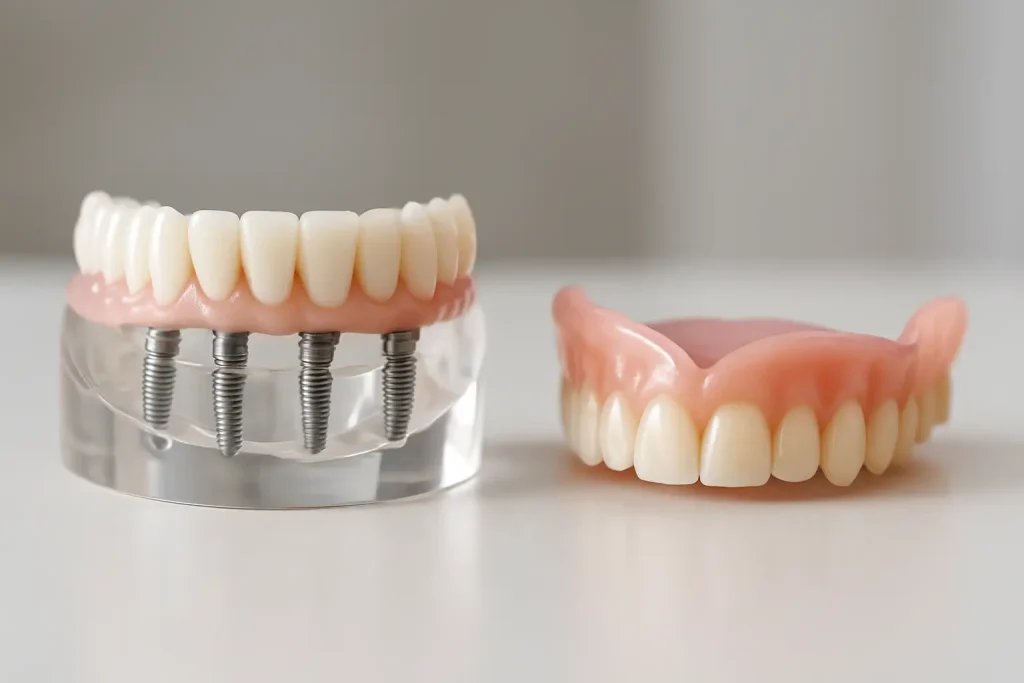
Dentures and All-on-4 solve the same problem in opposite ways. A denture is a removable acrylic plate that rests on your gums and stays put with suction and paste. All-on-4 uses four titanium posts placed in your jaw to hold a fixed bridge that we do not take out. One sits on top of the gums. The other locks into bone.
A traditional upper denture covers the roof of your mouth. The lower one rests on the jaw ridge and relies on your tongue and adhesive to stay in place. Because nothing connects them to bone, they can shift when you chew or talk.
All-on-4 places two implants straight in the front and two at an angle in the back. The angled posts reach thicker bone. That angle often means you can skip a bone graft, even when the back of the jaw is thin. Once we attach the bridge, it works like a set of fixed teeth.
What Does Each Cost Over the Long Run?
Sticker price tells only half the story. Dentures win on day one. Over 10 to 20 years, the gap narrows because dentures carry ongoing costs that All-on-4 does not. Add up relines, remakes, and adhesive, and the yearly cost of implants starts to look competitive.
Here is the pattern we see. A denture wearer buys the first set, then pays for relines every few years as the jaw changes shape. Around year five to seven, the denture needs a full remake. Adhesive is a steady expense, month after month. None of it is dramatic on its own. Together it adds up across a decade.
All-on-4 front-loads the spend. In Washington, one arch commonly falls between $15,000 and $30,000. After that, upkeep is modest: regular cleanings and the occasional check of the bridge. The prosthetic teeth may need refurbishment somewhere around year 12 to 15, but the implant posts themselves are built to last much longer.
Insurance rarely covers the full implant procedure. Many plans do pay toward parts of it, such as extractions or imaging. We bill out-of-network insurers, apply what your plan allows, and give you the out-of-pocket figure before we start. CareCredit, Cherry, and Sunbit offer financing that spreads the balance into monthly payments.
Here is how the two options line up side by side.
| Factor | All-on-4 | Traditional Dentures |
|---|---|---|
| Up-front cost per arch | $15,000 to $30,000 | A few thousand for both arches |
| Chewing force vs. natural teeth | 70 to 90 percent | 10 to 20 percent |
| Surgery | Yes | No |
| Removable | No, fixed in place | Yes, daily |
| Jawbone loss | Largely slowed | Continues over time |
| Adhesive | Never | Often daily |
| Typical lifespan | 20-plus years for the posts | 5 to 7 years before a remake |
| Routine upkeep | Cleanings, occasional bridge check | Relines, repairs, replacements |
These are general ranges. Your own numbers depend on bone quality, how many implants you need, and the prosthetic material you choose.
Which One Chews and Feels Better?
For daily function, All-on-4 has the clear edge. Fixed implant bridges restore about 70 to 90 percent of natural bite force, while dentures manage only 10 to 20 percent. That difference decides whether you can bite into an apple or a steak without a second thought. Comfort and speech also tend to favor a bridge that stays put.
Chewing is where patients notice the biggest change. With All-on-4, hard and chewy foods go back on the menu. Denture wearers often avoid nuts, corn, and tough cuts of meat because the plate slips or hurts.
Speech is the other daily factor. A new denture takes weeks to get used to, and an upper plate resting against the tongue can create a mild lisp on certain sounds. An All-on-4 bridge leaves the palate open, so most people speak normally right away.
Then there is taste. An upper denture covers the roof of your mouth, which dulls flavor and temperature. All-on-4 keeps the palate uncovered, so food tastes the way it should.
Bone Loss and Your Face Over Time
This is the factor most people miss. When teeth come out and nothing replaces the roots, the jawbone slowly shrinks. Dentures sit on top and do not stop it. Implants engage the bone and help preserve it, which protects the shape of your lower face over time.
The dental term is resorption. Your body removes bone it no longer thinks it needs. Within about five years of full tooth loss, a person can lose a quarter or more of the ridge height that once held their teeth. Over 10 to 15 years, the lower face can shorten and the chin can rotate forward. That is the sunken look linked with long-term denture wear.
Implants interrupt that process. The titanium post takes chewing force and passes it into the jaw, which signals the body to keep the bone. The American Academy of Implant Dentistry and the American Academy of Periodontology both describe this bone-preservation effect. It is one of the strongest long-term arguments for a fixed solution.
How Long Does Each Option Last?
All-on-4 lasts far longer than dentures. Reviews published in the International Journal of Oral and Maxillofacial Implants put implant survival above 95 percent at the 10-year mark, and the posts themselves can last decades with good care. The bridge on top may need refurbishment around year 12 to 15. Dentures need relining every two to three years and a full remake every five to seven years as the bone underneath keeps changing.
Care matters for both. All-on-4 asks for daily brushing, floss made for implants, and cleanings twice a year. A denture needs nightly removal and cleaning, plus periodic professional adjustment. Neither is maintenance-free, but the implant timeline stretches much further between major costs.
Habits also play a part. Grinding, smoking, and skipped cleanings shorten the life of either option. We check the fit of a denture and the health of the tissue around each implant at every visit, so small problems get caught before they turn into a remake or a repair.
Who Is Each Option Right For?
There is no single answer, and the honest recommendation depends on your health and goals. Dentures still make sense for some people. All-on-4 fits others better. A consultation and a scan settle it far better than any article can.
Dentures tend to be the better call when cost is the deciding factor and financing still cannot bring implants within reach. They also suit patients who are not surgical candidates because of certain medical conditions, or who simply prefer a non-surgical route.
All-on-4 tends to fit when you want fixed teeth you do not have to think about, when protecting your jawbone matters to you, and when strong chewing function is a priority for your diet and daily life. The angled implant placement also helps people whose past dentist ruled out traditional implants for lack of bone.
Many people already wear dentures and come in because they are tired of the slipping, the paste, and the food they have given up. For them the question is not which to try first. It is whether their bone can support implants now. A scan answers that quickly.
Talk It Through in East Wenatchee
If you live in East Wenatchee or anywhere in the Wenatchee Valley, the next step is simple. Book a consultation with Matt Fluegge, DDS, at Fluegge Dental. We take a scan, look at your bone and your bite, review your insurance and financing, and give you a straight recommendation for your situation.
Call our dental clinic in Wenatchee at (509) 888-3384 to schedule your consultation.